I build WordPress sites for a living. It’s what Prystine does. It’s what I’ve spent most of the last decade doing.
So when it came time to rebuild my own personal site, naturally I reached for WordPress. Set up a local install, stared at it for a bit, then closed the tab.
The honest reason I didn’t use WordPress this time is that I didn’t need to. That probably sounds like a betrayal coming from a WordPress agency, so let me explain.
It’s a content site. It just needed to be fast and simple.
My personal site – joshcox.co.uk – is a handful of static pages and a (small) blog. There’s no dynamic content, no user accounts, no form submissions being stored anywhere, no WooCommerce. Nothing that actually requires a database sitting behind it.
WordPress is brilliant for what it does, and I’ll keep building client sites on it every day – where appropriate. But spinning up a WordPress install for a simple personal portfolio is a bit like driving a lorry to the corner shop. You can. It’s just not the right tool.
I’d been wanting to try Astro properly for a while. The pitch is straightforward: ship as little JavaScript as possible, be static by default, and only hydrate the bits that actually need it. For a content site, it’s genuinely the right call. The build is clean, the output is lean, and it deploys to Cloudflare Pages in seconds. No PHP, no database, no plugin updates to ignore for six months.
It also forced me to actually think about what I wanted the site to be, rather than just porting the old WordPress install across and calling it done.
The design came from a telescope
This is the bit I wasn’t expecting to write about, but here we are.
My daughter got a telescope for her 4th birthday. The first clear night we took it outside, we saw the moon through it, nothing dramatic, just the moon, visible from our back garden. But there’s something about seeing it with your own eyes that hits differently to a photo on a screen. The scale of it lands. It stops being information and starts being a feeling.
We’ve been out in the garden a few nights since. Looking at constellations, watching the moon go through its phases.
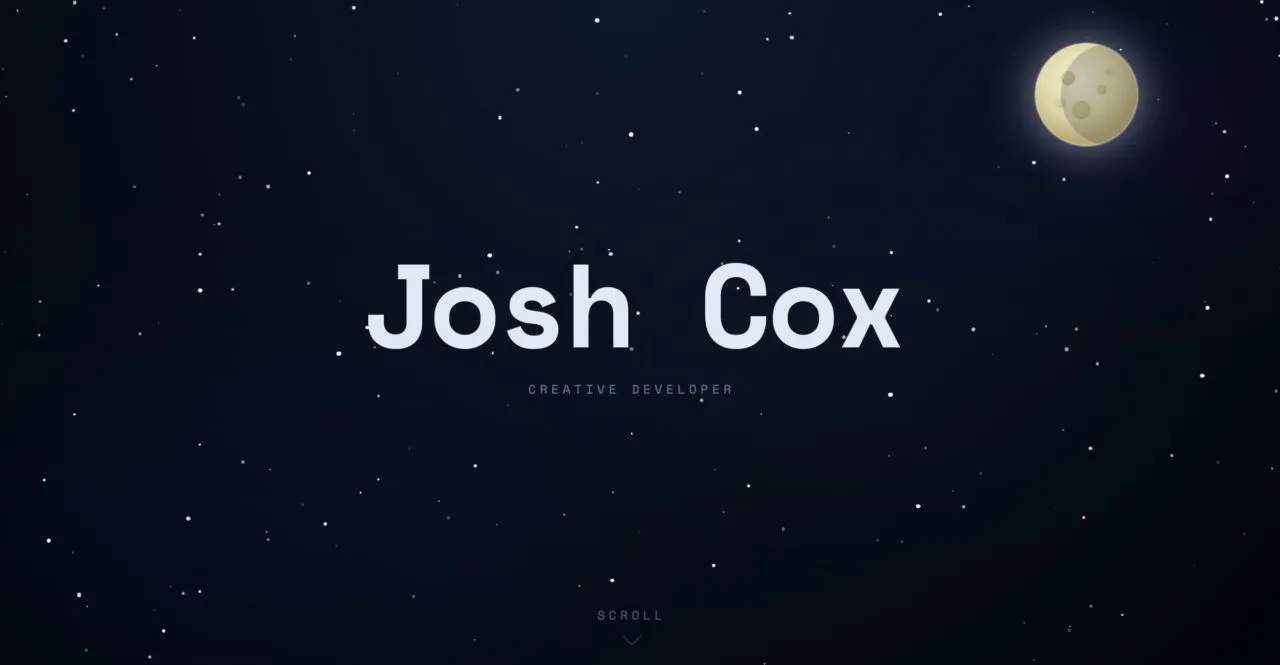
When it came time to design the site, I kept coming back to that feeling. The stillness of standing outside at 8pm, neck tilted back, everything else paused. The starfield on the site, the constellations that draw themselves in as you scroll; none of it is accidental. Each constellation represents a section: me, my work, the stack I use. Simple shapes made from the same dots you’d find in any star chart. They draw in line by line, the same way you trace a pattern in the sky once someone points it out to you.
I’m not sure a personal site needs a concept. But I like that this one has one.
Screenshot of my new site at joshcox.co.uk
What this means for client work: nothing, really
WordPress is still the right answer for most client projects. Flexible content management, a familiar editing experience, a massive ecosystem of plugins and builders. That hasn’t changed.
But not every site needs it. If you’re building something primarily content-driven, with no complex back-end requirements, it’s worth at least asking the question. Sometimes the simpler option is also the better one.
If you want to have a look at the site: joshcox.co.uk. The moon is clickable and for the gamers… Konami! That’s all I’ll say about that.

Josh Cox
I'm Josh — I build, host and look after WordPress sites (and increasingly fast Astro / Next.js builds) for Oxfordshire businesses, from Didcot, since 2016. I also tinker with a few products of my own on the side.