


Updated October 2026: I’ve added the most common types of social engineering and replaced an old statistic with the latest UK government figures.
Social engineering is a form of cyber crime where criminals will use human interaction to try to steal sensitive data or money, gain access to systems or deliver malware. The criminals rely on manipulation or human error rather than vulnerabilities in software to achieve their goals.
It’s a broad category that covers many different types of attack, such as phishing, scareware, vishing, baiting, spear phishing and more.
Common types of social engineering
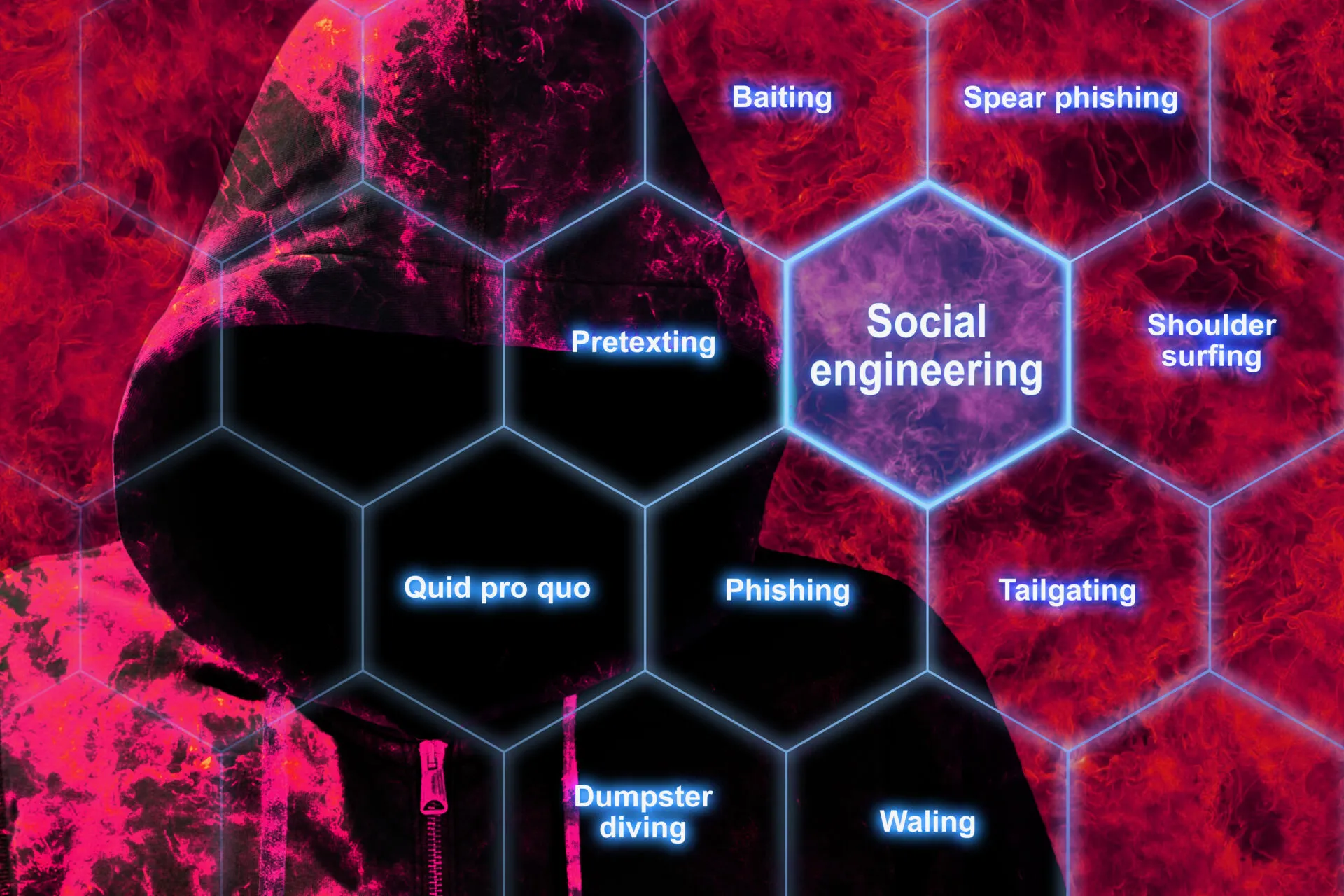
- Phishing: fake emails pretending to be from a trusted company or person, trying to get you to click a link, open an attachment or pay an invoice. Spear phishing is the targeted version, tailored to a particular business or person. Smishing (texts) and vishing (phone calls) are the same trick by other means.
- Pretexting: the criminal invents a believable story (the pretext) to get information out of you. Think a call from “IT support” who need your password to fix a problem, or an email from your “managing director” asking for an urgent payment.
- Baiting: tempting you with something you want, like a free download, a prize or a USB stick left lying around, which then installs malware or harvests your details.
- Tailgating: following someone with a pass through a secure door, often while carrying boxes or chatting away, so staff hold the door out of politeness.
- Scareware: pop-ups warning that your computer is infected and pushing you to install fake “security” software, which is the real malware.
It’s a big problem
The UK government’s Cyber Security Breaches Survey 2025/2026 found that 43% of UK businesses had a cyber security breach or attack in the previous 12 months. Phishing was by far the most common type, experienced by 38% of businesses.
Part of the reason is that traditional cyber defences (such as firewalls & anti-virus) have become increasingly better over the years at preventing attacks. Meanwhile, human error and a lack of training and awareness mean criminals increasingly target people as the weak point.
What can you do to combat social engineering attacks?
There’s a whole host of defences organisations can use to help prevent social engineering attacks, so I recommend speaking to a security expert. If you need a contact, ask me for a referral; I’m happy to help.
I provide user awareness training and phishing simulations to help build your human firewall. However, this is only one part of your overall defence strategy. My blog post on building your human firewall has some practical first steps.